
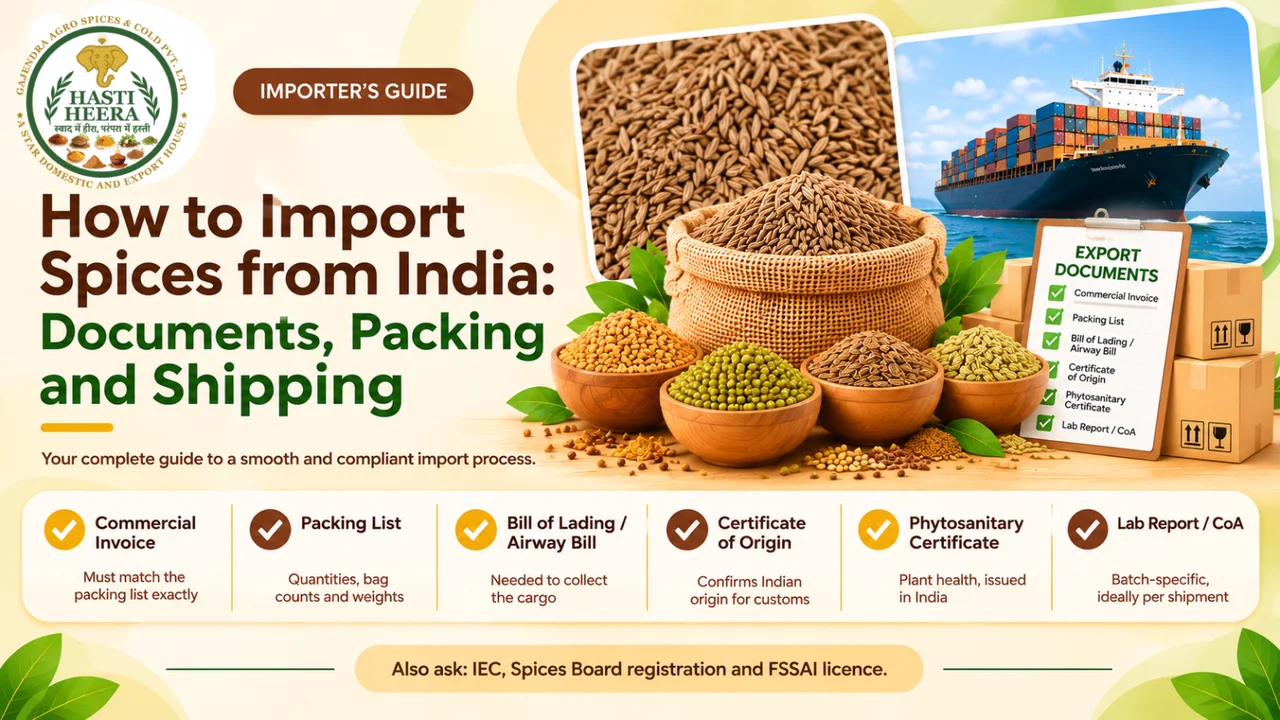
A practical guide for first-time importers: what to ask your supplier for, how bulk spices travel and what to check before you place the order.
Placing your first spice order from India? The spices are the easy part. It's the paperwork, packing and shipping where orders most often get delayed.
This guide walks you through what to ask for, how bulk spices are packed and shipped, and which new rules could affect your consignment.
Who is allowed to export spices from India?
Not every trader can ship spices abroad. Exporters need an Importer Exporter Code (IEC) from the Directorate General of Foreign Trade, and they must register with the Spices Board of India, which issues a Certificate of Registration as Exporter of Spices.
Most Indian food businesses also hold an FSSAI food licence and a GST registration.
Before you talk price, ask a supplier to show you their IEC, Spices Board registration and FSSAI licence. A genuine exporter shares these without hesitation.
It also helps to deal directly with a manufacturer or a long-standing exporter. We're based in Merta, Rajasthan, and have worked with cumin, fennel, fenugreek and mustard for decades, so these are the questions we hear most often from new importers.
Which documents do you need for a spice import?
A standard bulk shipment usually comes with these papers:
- Commercial invoice and packing list. They must match each other exactly, down to quantities and descriptions.
- Bill of lading (sea) or airway bill (air). This lets you take delivery of the cargo.
- Certificate of origin. It confirms the goods are of Indian origin and is often needed for customs and duty.
- Phytosanitary certificate. It's issued by India's plant protection authorities and confirms the consignment meets plant health requirements.
- Lab test report or certificate of analysis. Ideally batch-specific. Many markets expect it.
- Fumigation certificate, if your country requires it.
Your own country may ask for more, such as an import licence, food business registration or a prior notice. Always check with your food safety authority and customs broker, because requirements vary by market.
What do importers get wrong about paperwork?
Most delays come from small mismatches, not big problems.
A different spelling of the consignee, a wrong HS code, a quantity that doesn't match between invoice and packing list, or an expired certificate can hold a container at port.
Send your supplier your exact company name, address and HS code requirements before the order is confirmed. Ask them to share draft documents so you can check them first.
How are bulk spices packed for export?
Packing protects flavour, colour and aroma during a long journey. For whole seeds like cumin, fennel, fenugreek and mustard, common choices include:
- Woven polypropylene (PP) bags or jute bags, often with an inner liner
- Paper or multi-layer bags for ground or cleaned products
- Bulk bags or retail packs, depending on your needs
Bag weights and pack types differ between suppliers and products, so confirm the pack size, labelling and pallet arrangement before you order. Labels should show product name, net weight, batch number, packing and expiry dates, and country of origin.
Moisture is the main enemy. Sea containers can see big temperature swings, so ask how the product is dried, cleaned and sealed, and whether anything is used to control moisture inside the container.
How does shipping work from India?
There are two common sea options:
- FCL (full container load): a whole container for your order. It's usually better for larger quantities.
- LCL (less than container load): your cargo shares a container. It suits smaller orders but has more handling.
Air freight is faster but costs much more, so it's mostly used for samples or urgent small lots.
Your quotation will use an Incoterm, such as FOB, CFR or CIF. This tells you who pays for and carries the risk of each stage. FOB means the seller delivers to the ship at the Indian port, and you take over from there. Make sure you and your supplier agree on the term and the port.
Payment terms are agreed before shipping. Common ones are advance payment, a letter of credit and documents against payment. New buyers often start with a smaller trial order to build trust.
Do new import rules affect your order?
They might, depending on where you're importing to. For example, the Spices Board of India issued a trade advisory in November 2025 about new UK rules that apply from 1 January 2026.
Under these rules, cumin and fennel seeds need an analytical report for pesticide residues. Spices under HS code 0910, such as ginger, turmeric and curry powders, need reports for pesticide residues and ethylene oxide. The advisory also says checks at UK entry points rise to 20% for these products.
The advisory itself says the Board is working on testing arrangements, and the details may change. So if you're importing into the UK, ask your supplier and your customs agent for the latest rules before you ship.
Other markets such as the EU and the US also run their own food safety checks. The safest approach is to ask your supplier for lab reports with every batch, and our guide on why a spice testing lab matters explains which tests to ask for.
What should you do before your first order?
A simple checklist:
- Verify the supplier: IEC, Spices Board registration and FSSAI licence.
- Order samples first, and test them against your own specification.
- Agree the specification in writing: purity, moisture, packing, quantity and grade.
- Confirm the Incoterm, port and payment terms.
- Ask for draft documents and check them against your import rules.
- Request a lab report for each batch.
- Talk to your customs broker early.
The bottom line
Importing spices from India isn't complicated, but it rewards preparation. A registered supplier, matching documents, proper packing and clear shipping terms prevent most problems.
If you're looking to source cumin, fennel, fenugreek, mustard, moong or moth, you can browse our spices and seeds range and tell us your requirement. We'll share specifications, packing options and a quote, and we'll help you work out which documents your shipment needs.
Get a quote | Chat with us on WhatsApp
Disclaimer: This guide is general information only. Import rules change, so always check the latest requirements with your country's authorities and a customs broker.
About the author: Written by the team at Hasti Heera by Gajendra Agro Spices, a spices manufacturer and exporter of cumin, fennel, fenugreek, mustard, moong and moth from Merta, Rajasthan, serving buyers since 1952. Learn more at gajendraagrospices.com.